


What is the soul of Shaolin culture?

The specialty of Chinese Buddhism lies in Zen. The essence of Shaolin culture also lies in Zen. Shaolin culture is an “organism” of Buddhist culture created, developed, evolved, displayed and coalesced with Shaolin Temple as a platform. Whether it is Zen, martial arts, medicine, astronomy, architecture, and so on, various cultural elements, although self-contained system, but between them are symbiotic, complementary, mutual cause and effect, each other, thus constituting a “living” cultural organism.
However, Shaolin culture is not a typical cultural form. It is rooted in Buddhist culture, and its roots lie in the faith of Buddhism and the spirit of Zen Buddhism. That is to say, no matter how the other elements of Shaolin culture are moved, stretched, or contracted, they cannot be separated from one center, which is the “center” of Buddhist belief or Buddhist spirit; In short, ‘Zen mind’ is the soul of Shaolin culture. Taking “Zen” as the “heart” (core) – here the Zen heart refers to the mind of meditation and purification, the mind of transcendence and transcendence, a character, a spirit, a wisdom, and a realm. Whether it’s Shaolin martial arts or Shaolin academia, only by sticking to this soul can we fully demonstrate the inner character of Shaolin culture and have lasting charm!
People are paying attention to Shaolin Temple

People are paying attention to the Shaolin Temple, but at the moment they are mainly concerned about Shaolin Wushu, the functions and charms of the martial arts. Shaolin Wushu has been the signature of Shaolin Temple. However, we consider Shaolin culture based on its overall and intrinsic charm, which requires researchers to focus especially on exploring the intrinsic spirit of Shaolin culture. As the cultural heritage of mankind, we should explore the inner spirit of Shaolin Wushu as well as other systems, and we should grasp the soul of the ideas therein. I agree with the use of the four words “Zen heart and martial arts”, which I think accurately captures the inner relationship between Shaolin’s ‘Zen’ and “boxing”. By analogy, the study of Shaolin culture and “Shaolinology” will be able to “summarize the outline”.
For the “Shaolinology”, I will talk about a few immature views
- The first point, “Shaolinology” or Shaolin human cultural heritage declaration, I think it is necessary to give it the value of faith positioning. For a long time, the Buddhist and martial arts circles have been arguing about the relationship between Shaolin martial arts and Shaolin Zen. In fact, Mr. Zhao Puchu once wrote an inscription for Shaolin Temple during his lifetime, “Shaolin is Zen, not boxing”, which clearly defines the faith orientation and value tendency of Shaolin culture. This “Zen” is the essence, this “martial arts” is the table, one for the nature of the body, one for the phase of use, between the two of them is like a person’s spiritual ideas and physical expression. Wushu is not a purely physical sport, it is a form of Wushu that originates from the Zen mind. This is in line with the spiritual pursuit of the Buddhist faith, which can define and standardize the future development direction of “Shaolinology”. The so-called value positioning, that is to say, Shaolin Temple is Shaolin Temple, it is a place of activity of Buddhist faith, this “Shaolinology” is not far from the social positioning of faith. Therefore, in the research process of “Shaolinology”, it is necessary to analyze and explore the ideological connotation of Shaolin culture and the many behavioral practices of the Shaolin Temple, whether it is in line with the beliefs of “Buddhism on earth” needs, whether it is a mode of implementation of the present world? In my opinion, it is an important issue to enhance the social value of “Shaolin Studies” and to clarify the direction and positioning of the future development of Shaolin culture, which is worthy of careful attention.
- Secondly, since Shaolin Wushu and other cultural systems are also attributed to the wisdom of Zen Buddhism, then, in the study of “Shaolinology”, I feel that the interpretation of many Shaolin Wushu routines can be given the value and significance of the idea of “Zenology”. For example, some martial artists analyze the martial arts routines, when talking about the association and characteristics of intention, gas, rigidity, flexibility, etc., often with “mysterious and inexplicable” to express, which already has the connotation of “thought” and the value of faith. Whether the intention of qi triggered, rigid and flexible, I think it is in the form, martial arts set on top of the real mysterious and inexplicable realm, absolutely not martial arts set can be reflected and expressed, which is actually embodied in the “Zen heart transport martial arts” concept. This is also true. The real martial arts master is definitely not in a move, the so-called intention to, gas to, force to, first of all, is a kind of conceptual, the mind on the free release, power on the strength of the degree of strength and weakness. This is the same as the Zen Buddhist concept of letting go of all thoughts and letting nature take its course. Also, for example, rigidity and flexibility are also applied in the process of Zen practice, Zen mind training, which is actually a deep, deep reaction of the mind to a shape.


In my opinion, in the study of Shaolinology, both martial artists and Zen scholars have to construct a proper, harmonious and close cooperative relationship. Therefore, in the study of Shaolin Wushu, no matter what angle you take in martial arts, you must have this basic “Zen” cultivation. I even think that the value of Shaolin Wushu will be even greater in the future if it is re-interpreted with the idea of “Zen”.
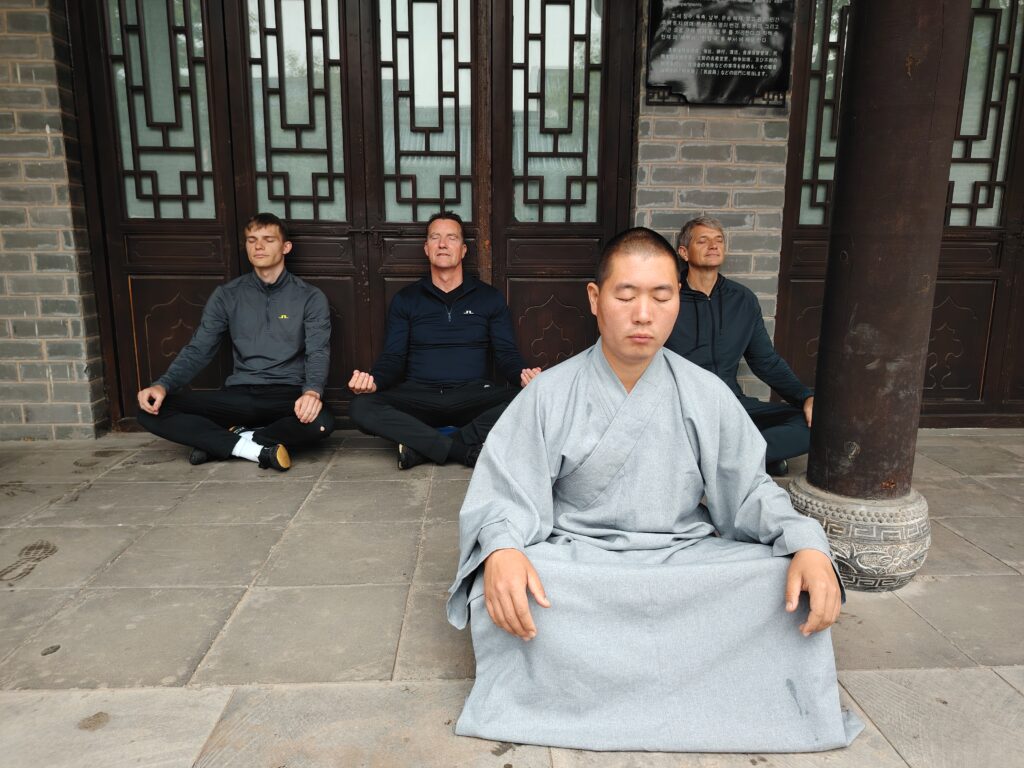
- Thirdly, based on the above considerations, I have a specific idea that Shaolin Temple, as the ancestral home of Chinese Zen Buddhism, should make its due contribution to the continuation of the spirit of Zen Buddhism. That is to say, “Shaolinology” can not only in the ‘learning’, there should also be “practice”, so that the combination of learning and practice, in order to make Shaolin culture into reality, into the hearts of people. Therefore, I suggest, in the Shaolin scenic area can build an international, huge capacity meditation center, for different cultural backgrounds around the world of Shaolin culture enthusiasts, Chinese Buddhist culture believers, to provide a solemn site for study, so that everyone here “to raise morality and fitness” “Zen Yue The center provides a solemn place for everyone to “cultivate virtue and fitness” and “Zen joy and wisdom”.
Summary
A meditation center should not be just a “meditation hall” constructed by a building, but should be set up according to the Buddhist beliefs and the ideological connotation of Shaolin culture, with relevant Dharma rituals and forms, to accommodate a wide range of reasons and to meet the needs of the situation. It is believed that after serious study and practice, cultivating morality and increasing wisdom, it is of great practical significance to purify people’s hearts and society, and to build a harmonious society together.